How to Tell If Your Windows Are Failing (Before They Fail Completely)
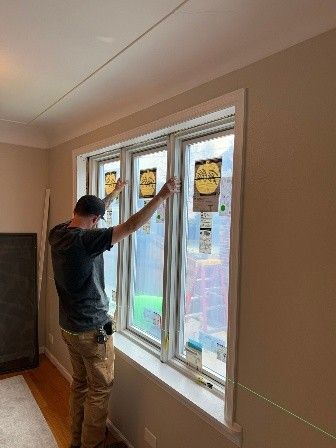
Most windows don't fail all at once. They fail gradually — a small draft here, a little condensation there, a frame that's getting harder to open. By the time most homeowners realize something is genuinely wrong, the problem has usually been developing for a year or two.
Colorado's climate accelerates window deterioration in ways that aren't always obvious. The combination of high UV intensity at altitude, significant daily temperature swings, dry air, and freeze-thaw cycles stresses seals, frames, and glass coatings faster than most homeowners expect. Knowing what to look for — and understanding what each symptom means — is the difference between catching a problem early and replacing damaged substrate alongside your windows.
Here are the five clearest signs your Colorado windows are failing, what's causing each one, and how urgent each situation actually is.
Sign 1 — You Can Feel Air Movement Near a Closed Window
Run your hand slowly along the perimeter of a closed window on a cold or windy day. If you feel air moving — even slightly — the window is no longer sealing properly.
This happens for three main reasons. The weatherstripping has compressed over years of use and lost its ability to form a tight seal. The window frame has warped slightly from thermal expansion and contraction, leaving a gap the weatherstripping can't bridge. Or the caulk between the frame and the rough opening has cracked or shrunk, allowing air to bypass the frame entirely.
In Colorado, where winter nights regularly drop below 10°F, even a small air leak means your heating system is working against the outdoors through that window. The urgency depends on the severity — minor weatherstripping compression can sometimes be addressed without full replacement, but frame warping typically cannot.
Sign 2 — Fogging or Cloudiness Between the Panes
This is the most definitive sign of a failed window seal. If you see fogging, streaking, cloudiness, or moisture between the two layers of glass in a double-pane unit, the insulating seal has broken down.
When a double-pane window is manufactured, the space between the panes is filled with argon or krypton gas, which is a significantly better insulator than air. When the seal fails, that gas escapes and is replaced by ordinary air — which also carries moisture. The result is the persistent fogging or haze that appears between the panes and cannot be cleaned because it's inside the sealed unit.
A failed window seal cannot be repaired. The insulated glass unit — or in most cases the whole window — needs to be replaced. The insulating performance of the window is already compromised; you're essentially paying to heat and cool through a single-pane window while it appears to be double-pane.
Colorado's UV intensity and temperature cycling accelerate seal failure, particularly on south- and west-facing windows. If you have fogging between panes on one window, inspect the others in the same orientation — they're often at a similar stage.
Sign 3 — Your Energy Bills Have Increased Without an Obvious Explanation
Windows account for 25 to 30 percent of residential heating and cooling loss. If your utility bills have been increasing and your usage habits haven't changed — same thermostat settings, same household size — your windows may be responsible.
This is especially relevant in Colorado where both summer cooling and winter heating demands are significant. Ageing or failed windows force your HVAC system to compensate for constant heat loss in winter and solar heat gain in summer. The effect is gradual enough that many homeowners attribute it to rate increases rather than window failure.
A useful test: on a cold night, hold your hand near the glass surface of each window (not the frame — the glass itself). Modern double-pane windows with Low-E coatings should feel only slightly cool. Single-pane windows or failed double-pane units will feel noticeably cold — close to outdoor temperature. The difference in thermal performance is tangible.
Sign 4 — Windows That Stick, Bind, or Won't Stay Open
Windows that are difficult to open, won't stay open without a prop, won't close fully, or no longer latch properly have structural issues that go beyond cosmetics.
Wood frames are the most vulnerable — they absorb and release moisture seasonally, and Colorado's dry climate followed by summer monsoon humidity creates significant expansion and contraction cycles over the year. Over time, wood frames can warp enough that the sash no longer moves freely in its track or closes flush against the weatherstripping.
Vinyl and fiberglass frames are more dimensionally stable but can still deform over time under Colorado's UV exposure and thermal load. A window that won't close fully is a weatherproofing failure regardless of the frame material — a partial gap allows air infiltration, moisture entry, and in ground-floor installations, a security vulnerability.
Sign 5 — Visible Deterioration at the Frame, Sill, or Glazing
Some window failure is visible before you feel a draft or see fogging. Look for:
- Paint peeling or bubbling around the frame: often indicates moisture is penetrating through failed caulk or a compromised glazing compound, entering the wall assembly, and expressing outward as blistering paint.
- Soft or spongy wood at the sill or frame: press gently with a screwdriver or pen at the corners and sill. Soft wood means rot has set in — usually from a long-standing moisture path the paint surface was hiding. Rotted substrate must be replaced before any new window will perform correctly.
- Cracked or missing glazing compound: in older single-pane windows, the glazing compound (putty around the glass perimeter) hardens and cracks over time, allowing water to enter. This is repairable in early stages but if ignored, leads to frame rot and glass displacement.
- Visible gap at the frame-to-wall junction:
shrinking or cracked caulk between the window frame and the exterior siding. Water enters here and follows the frame down into the wall, often for years before showing up as interior damage.
What to Do When You Spot These Signs
Not every symptom means immediate full replacement — some can be addressed with weatherstripping, recaulking, or minor repair. But in Colorado's climate, the window failure signs above tend to compound: a failed seal accelerates UV damage to the frame, which allows moisture infiltration, which leads to rot. Catching any of these signs early gives you more options and usually a lower total cost.
If you're seeing one or more of these signs and want a professional assessment, Formula Roofing & Remodeling provides free window efficiency assessments across the Denver Metro area. Visit our
windows and doors page for full details or go directly to our
Aurora window installation page or
Boulder window installation page if you're in those areas. Call
(303) 600-8696 to schedule.